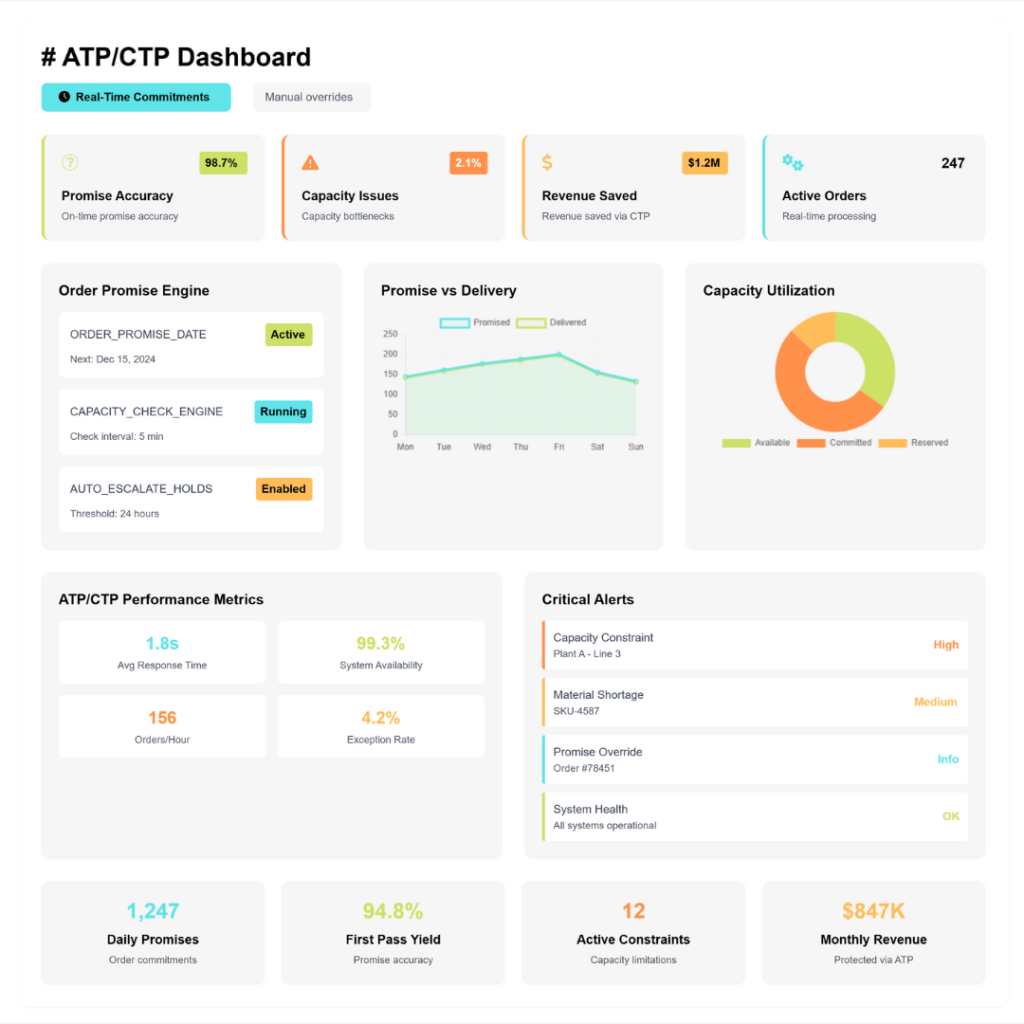
Master Production Planning
That Optimizes Capacity & Serviceability
Advanced planning that harmonizes MILP & Heuristics-derived optimality with the tacit knowledge of your seasoned planners.
Core Capabilities
Precision Production Orchestration
Advanced algorithms that optimally navigate industrial complexity and divergent objectives while respecting operational constraints.
01
Constraint-Aware Sequencing
Mathematically optimal planning that accounts for material & capacity constraints and production planning rules.
02
Multi-Objective Synchronization
Balanced optimization of throughput, cost efficiency and flexibility in a unified solution.
03
Closed-Loop Adaptation
Self-improving models that evolve using real-world performance feedback and deviations.
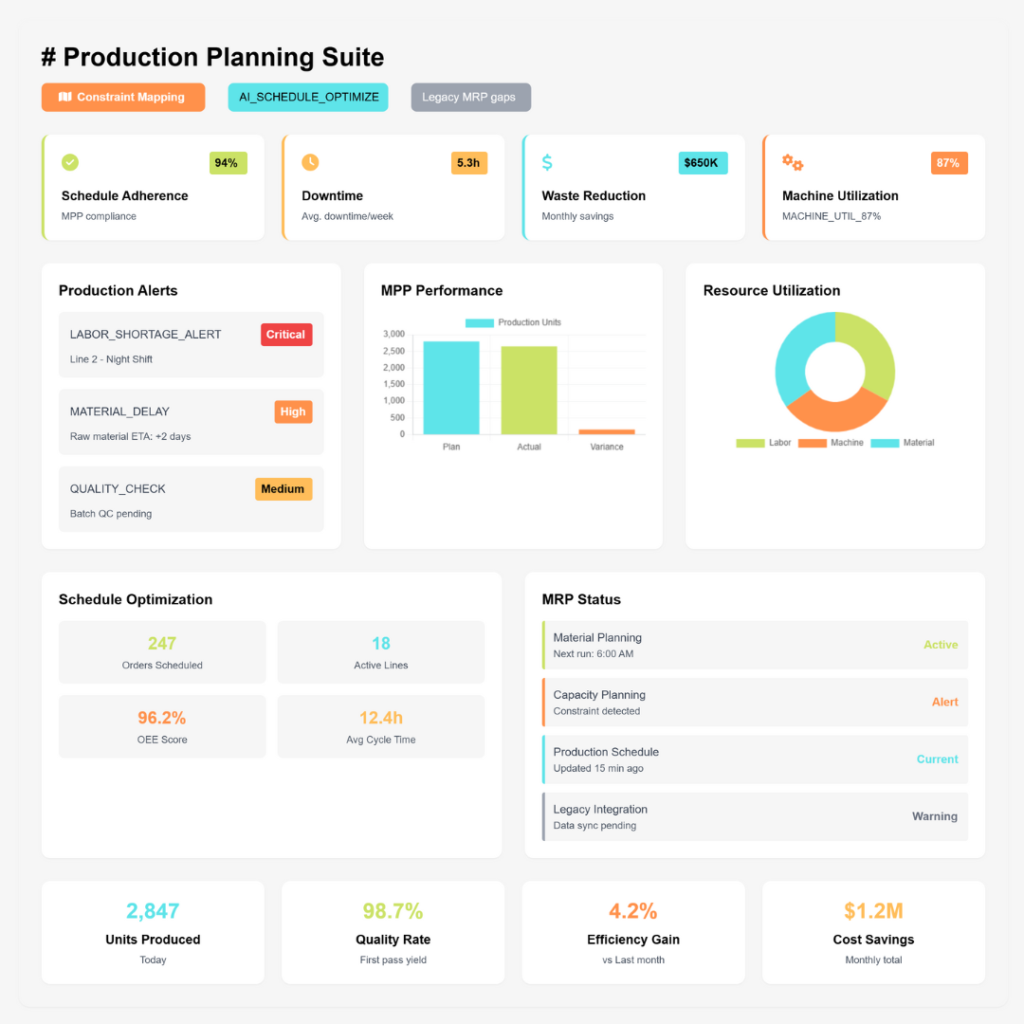
Why It Works
Precision Planning Engine
Mathematically rigorous production planning that evolves with your operations.
Constraint-Optimal Production Planning
MILP-driven planning that optimizes between competing objectives of capacity utilization, on-time delivery, serviceability resulting in about 15% improvement in production and 10% improvement in lost sales
Human-Algorithm Collaboration
Planners override algorithmic suggestions with tracked rationale, maintaining auditability while leveraging expertise.
Live Performance Adaptation
Reinforcement learning adjusts for changes in demand and supply in weekly time buckets.
Multi-Plant Synchronization
Coordinate bottleneck resources across facilities using decentralized optimization.
How Production Planning
Embeds in Your Operations
Seamlessly adapts monthly production targets with weekly changes in demand & supply variations.
-
Manufacturing Data
Connect Live -
Optimization Rules
Customize -
Scenario Analysis
Automate -
Bottleneck Forecasts
AI-Driven
Your Shop Floor, Digitally Mirrored
Real-time ingestion of MES/SCADA data (OEE, tool wear rates, energy consumption) through Apache Kafka pipelines with event-time processing.
Automatic mapping of your unique constraints – from chemical batch dependencies to union break schedules – into optimization parameters.
- Works with SAP PP-PI
Your Physics, Encoded
Define sequence-dependent changeover matrices (e.g. 4hr cooling period between alloy grades) as hard constraints.
Dynamic priorities that shift in real-time during high demand or limited supply.
- Drag-and-drop constraint builder
- Version-controlled rule sets
Stress Test Before Committing
Run Monte Carlo simulations on your digital twin to evaluate schedule robustness against:
- Machine breakdowns (MTTR/MTBF - based)
- Rush order insertion
- Absenteeism patterns
Visualize Pareto frontiers showing trade-offs between makespan, energy cost and labor utilization.
- Compare top 3 schedule options
- Export risk reports to PowerPoint
See Next Week's Fire Drill Today
Topological analysis of your production network identifies emerging constraints using:
- Centrality metrics for resource criticality
- Petri net simulation for cascade effects
Recommends buffer stock positions or preventive maintenance to avoid disruptions.
- Alerts for >80% resource utilization
- Integrates with CMMS systems
Built for Supply Chain Realities
Algorithms that break down complex large-scale problems into manageable subproblems, ensuring globally optimal solutions, leveraging historical data for efficient warm-start initialization.
GPU-accelerated chance-constrained optimization evaluates over 10,000 scheduling scenarios per second, enabling rapid risk assessment under uncertain and volatile demand conditions.
Benchmark Your Scheduling Intelligence Quotient
Discover where your current planning process stands against MILP-optimal standards and how much better your utilization could be.